
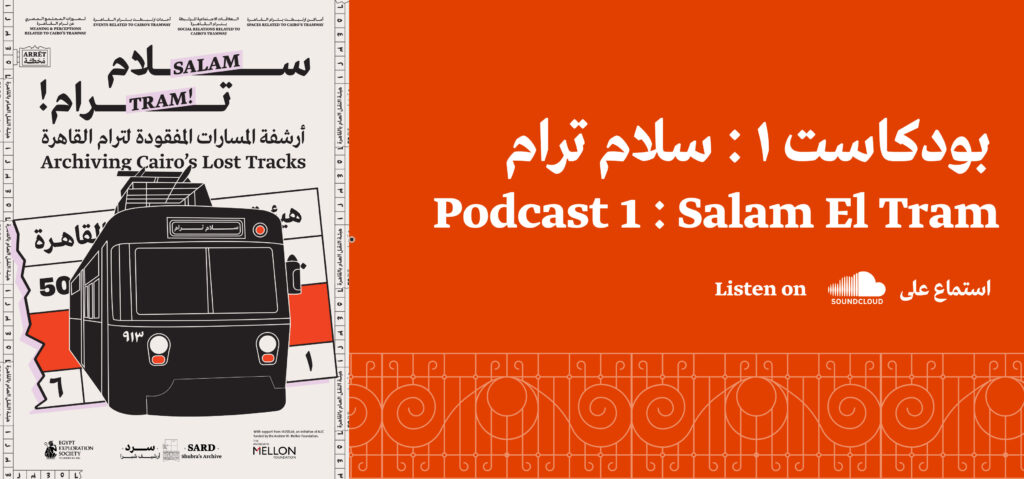
“Salam El Tram” is the first podcast series produced by Shubra Archive. While the name may suggest stories about the tram itself, the episodes go far beyond that. Drawing extensively on the archives of the Belgian tram company that held the concession to construct and operate Cairo’s tram network in the early 20th century, the series tells a broader story — one about Egyptian lives, the transformation of the city, and how the presence of the tram shaped everyday urban experiences.
To understand the social impact of the tram system, the team turned to both historical sources and oral testimonies gathered from local residents. These accounts helped fill gaps left by the absence of written records, especially for the second half of the 20th century. The result is a journey through the tramlines of memory — an exploration of how the tram continues to live on in Egypt’s collective memory, despite its physical disappearance.
Rather than offering fixed conclusions or ready-made solutions, Salam El Tram invites listeners to reflect on past urban dynamics and their connections to present-day issues. It is a historical product designed to think through — and with — the complexities of urban life. That is why the podcast is narrated in Egyptian Arabic: the language used by people in their daily lives, on and off the tram. Writing in spoken Arabic, however, was far from simple — as the team discovered, it carries its own richness, complexity, and layers, especially when dealing with archival and historical material.
The series was produced with support from the Social and Human Sciences Lab at the American University in Cairo and the Egypt Exploration Society. It was recorded at Amir Mousa Studio in Cairo. Scriptwriting workshops were led by writer and translator Hussein El-Hajj, with vocal training by radio presenter and artist Linda Bilal. Sound design and mixing were done by engineer Nehad El-Absy. All episodes were written, edited, and narrated by the Shubra Archive team.